




In the previous posts, we covered the basics and explored three key financial applications on Ethereum. Now let's zoom out and look at the Ethereum’s core principles and how they allow for open innovation.
Innovation
In the previous posts, we covered the basics and explored three key financial applications on Ethereum. Now let's zoom out and look at the Ethereum’s core principles and how they allow for open innovation.
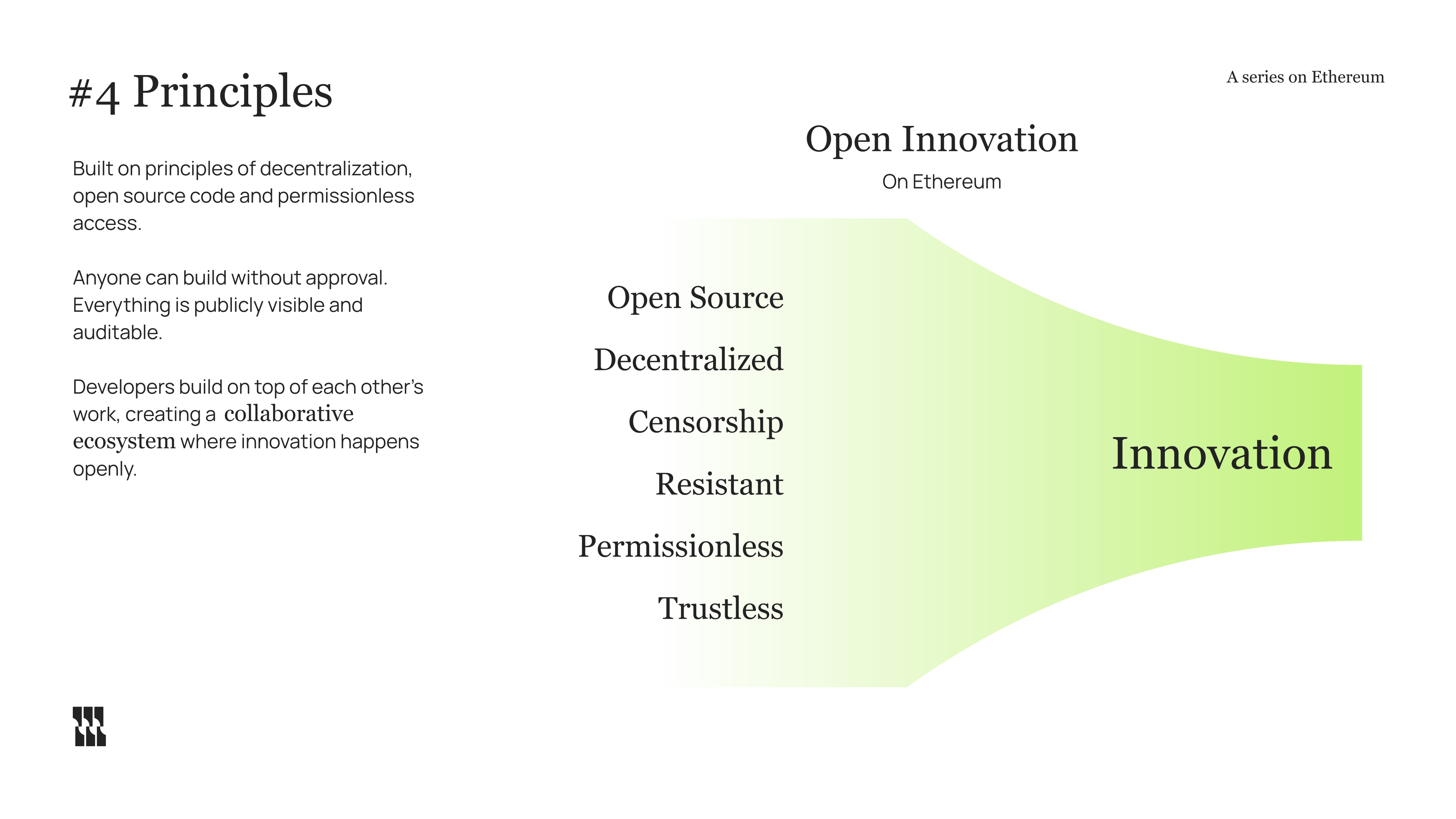
Ethereum's Core Principles
Ethereum was built on values that make open innovation possible:
- Decentralization: Thousands of independent computers worldwide verify transactions and run the network.
- Permissionless: Anyone, anywhere can use Ethereum without asking for permission.
- Trustless: You don't need to trust intermediaries like banks or brokers.
- Open source: All of Ethereum's code is publicly available. Anyone can inspect it, audit it, copy it, or build on top of it.
- Censorship-resistant: Once a transaction is confirmed, no one can reverse it, block it, or censor it.
These principles create an environment where innovation happens openly and collaboratively rather than behind closed doors.
How Building on Ethereum Works
Anyone can build on Ethereum without permission because all code is open source and publicly available. All the tools, documentation, and testing environments are freely available. Once you've built something, it's visible to everyone. The community can audit, verify, and trust what's been built.
This creates a very collaborative ecosystem where developers build on each other's work rather than starting from scratch.
For example: ERC-4626 (an Ethereum standard) was built for tokenized vaults in DeFi. But it had limits for assets needing time to process. So developers built ERC-7540 and ERC-7575 right on top of it, extending the original technology without breaking it.
This is exactly what open innovation should look like; leveraging both internal and external ideas, knowledge, and pathways to advance.

