




Mapping the concrete technical improvements Ethereum can bring to traditional finance.
TradFi Solutions
Mapping the concrete technical improvements Ethereum can bring to traditional finance.
Let’s dive into the six main pain points in traditional finance, along with the proposed Ethereum-based solutions.
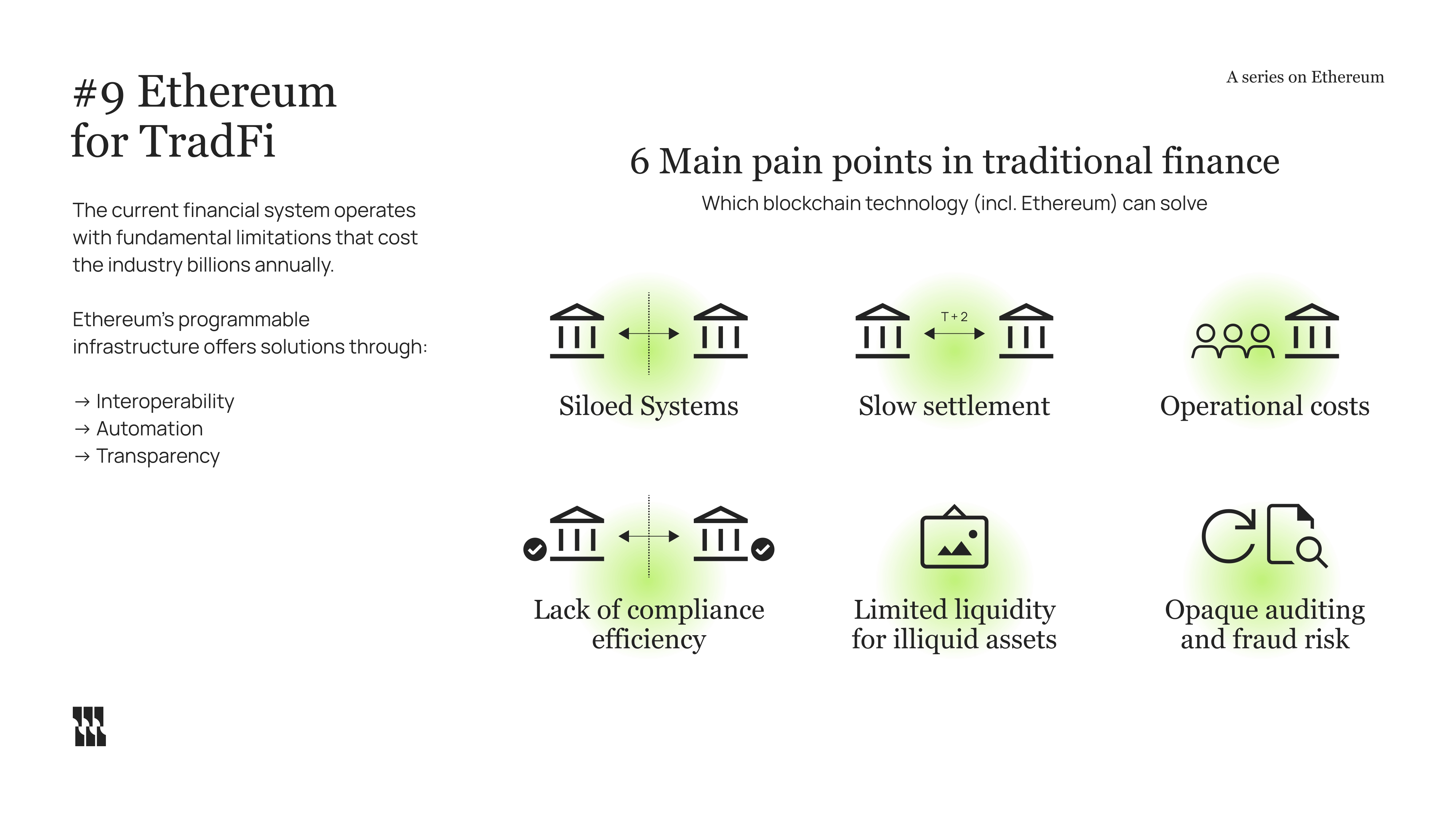
Problem 1: Siloed systems
Currently: Bank A operates on its proprietary ledger, while Bank B uses a different one. This results in a fragmented financial ecosystem that is poorly connected, especially for international transfers. This leads to mismatched data and thus to lengthy reconciliation processes and settlement delays.
Onchain solution: Interoperability standards and Ethereum’s composability enable a unified, open financial network. Institutions can exchange data and assets seamlessly, without relying on integration bridges.
Problem 2: Slow settlement
Currently: Settlement times often stretch to several days under the T+2 standard (and even longer for cross-border transactions). This ties up capital and exposes parties to counterparty risk if one side defaults mid-process.
Onchain solution: Moving operations onchain enables atomic settlement, where all transaction components execute simultaneously, or not at all.
Problem 3: High operational costs
Currently: Traditional finance operational costs reach $20–30 billion annually, driven by manual reconciliation, multiple intermediaries, and large back-office teams resolving discrepancies across siloed systems.
Onchain solution: Ethereum smart contracts automate many of these manual processes, delivering estimated cost reductions of 35–65%.
Problem 4: Lack of compliance efficiency in transfers
Currently: Transfers require KYC/AML verification, whitelisting, and the ability to freeze assets. These requirements often result in slow, inconsistent, and expensive operations as institutions need to navigate complex global regulations.
Onchain solution: Programmable tokens can automate compliance by embedding rules such as KYC checks and transfer restrictions. Standards like ERC-3643 and ERC-7943 make this approach viable at scale.
Problem 5: Limited liquidity for illiquid assets
Currently: Assets such as fine art or real estate are trapped in illiquid markets, making them difficult to trade quickly, value accurately, or access for smaller investors due to high barriers and slow processes.
Onchain solution: Through real-world asset (RWA) tokenization, illiquid assets can become significantly more liquid. Tokenization enables easier trading and fractional ownership, allowing assets to be divided into smaller units. Combined, these mechanisms unlock 24/7 liquidity.
Already, more than $10 billion in U.S. Treasuries have been tokenized using this model.
Problem 6: Opaque auditing and fraud risk
Currently: Fragmented private ledgers limit visibility, making audits labor-intensive, disputes frequent, and fraud difficult to detect due to unverifiable records and manual data reconstruction.
Onchain solution: Blockchain transactions are permanently recorded on an immutable ledger. If fraud occurs, it becomes immediately visible and traceable. This level of transparency can reduce errors by over 60% and enables real-time auditing for all stakeholders.
Final thoughts
These innovations are substantial and highlight the new era finance is coming. Though, i’d like to highlight that these changes will not happen overnight, and that’s okay.
The internet took roughly 30 years to be fully adopted, and now it’s unthinkable to live without it. This is what we expect to see with onchain finance as well. Through continuous learning, iteration, and collaboration, we can build a more efficient, transparent, and resilient financial infrastructure for future generations.
And then we might perhaps reach a day that nobody is talking about onchain finance, crypto, blockchains, ledgers or ERC standards. It will all just be finance.
In the next article, we’ll cover the leading ERC standards currently used in traditional finance and explore their real-world impact.

