




The current financial system is siloed. ERC standards can innovate this. In this article we will discuss how standards can drive financial innovation, and the critical pitfalls we need to avoid.
Siloes
The current financial system is siloed. ERC standards can innovate this. In this article we will discuss how standards can drive financial innovation, and the critical pitfalls we need to avoid.
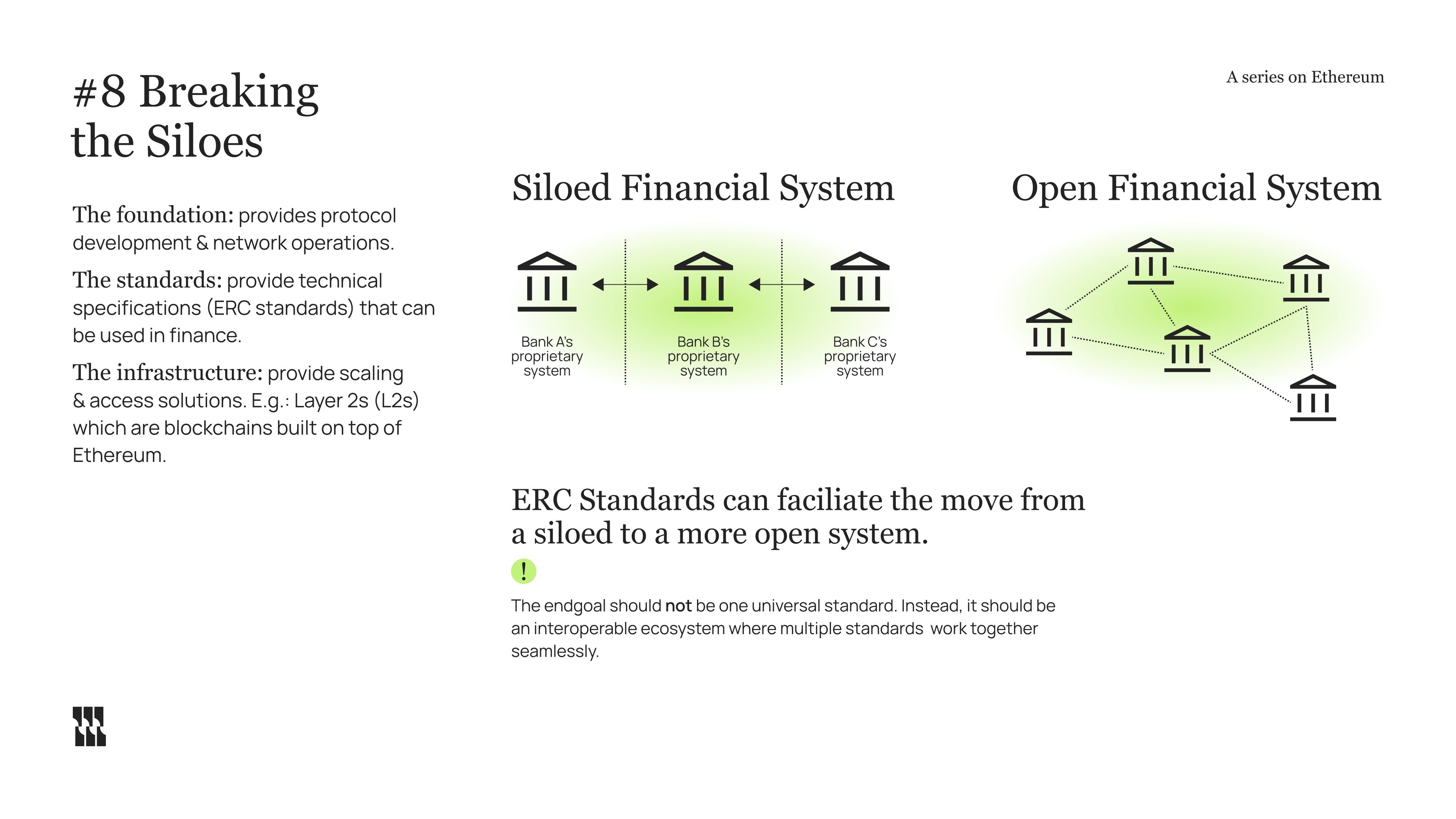
The Current Financial System:
Built in Silos
Traditional corporate finance has evolved through many waves of innovation since. Here’s a quick recap of the past 50-ish years:
- 1973: SWIFT network launches for secure global payments.
- 1970s: Computerized clearing houses replace paper checks.
- 1980s: Electronic trading floors and ATMs go mainstream.
- 2000s: T+2 settlement standards and Dodd-Frank regulations speed up markets.
But today's system remains "siloed", meaning Bank A operates on its proprietary system, Bank B on theirs, with minimal overlap. This creates:
→ Slow transactions: T+1 or T+2
→ Innovation boundaries: When Bank A develops new solutions through R&D, they keep it internal or sell it to competitors
→ Limited collective progress despite significant individual investment
This is standard practice in our market structure, but it fundamentally limits how fast we can innovate.
Breaking Down the Silos
To truly transform the financial system, we need collective innovation. We need to break down these silos together. This is where ERC standards come in.
But Wait…Aren't Standards Just Another Form of Centralization?
Here's the concern: The word "standard" suggests centralization: One and only one way of operating. Unless everyone adopts that standard, it loses value. This sounds like we're just replacing one silo with another, right?
The ERC standard solution:
There are thousands of ERC standards, each serving different use cases. While a few have emerged as market leaders for regulated financial institutions, the key insight is this:
Different ERC standards suit different institutions, different use cases and different asset classes.
At Framework Labs, we created a framework categorizing ERCs on a spectrum from "Flexible Frameworks" (minimal interfaces, letting adopters choose implementation) to "Prescriptive Standards" (specific technical architectures and mandatory logic).This goes beyond the scope of this series. Therefore, the full breakdown is be published in our report on ERC standards for risk managers and compliance officers in financial institutions.
The Path Forward
The opportunity (and responsibility) falls to innovation managers and digital asset decision-makers within financial institutions. They must understand which standard(s) best serve their needs.
The endgoal should not be one universal standard. In my opinion, it should be an interoperable ecosystem where multiple standards work together seamlessly.
Only then will we have truly broken down the silos.
The next post will cover the technical benefits that Ethereum is offering to innovate traditional finance.

