




In previous posts, we explored the five layers that shape the Ethereum ecosystem. In this article we will dive into one layer that will define digital assets: Standards.
Standards
In previous posts, we explored the five layers that shape the Ethereum ecosystem. In this article we will dive into one layer that will define digital assets: Standards.
Defining Standards on Ethereum
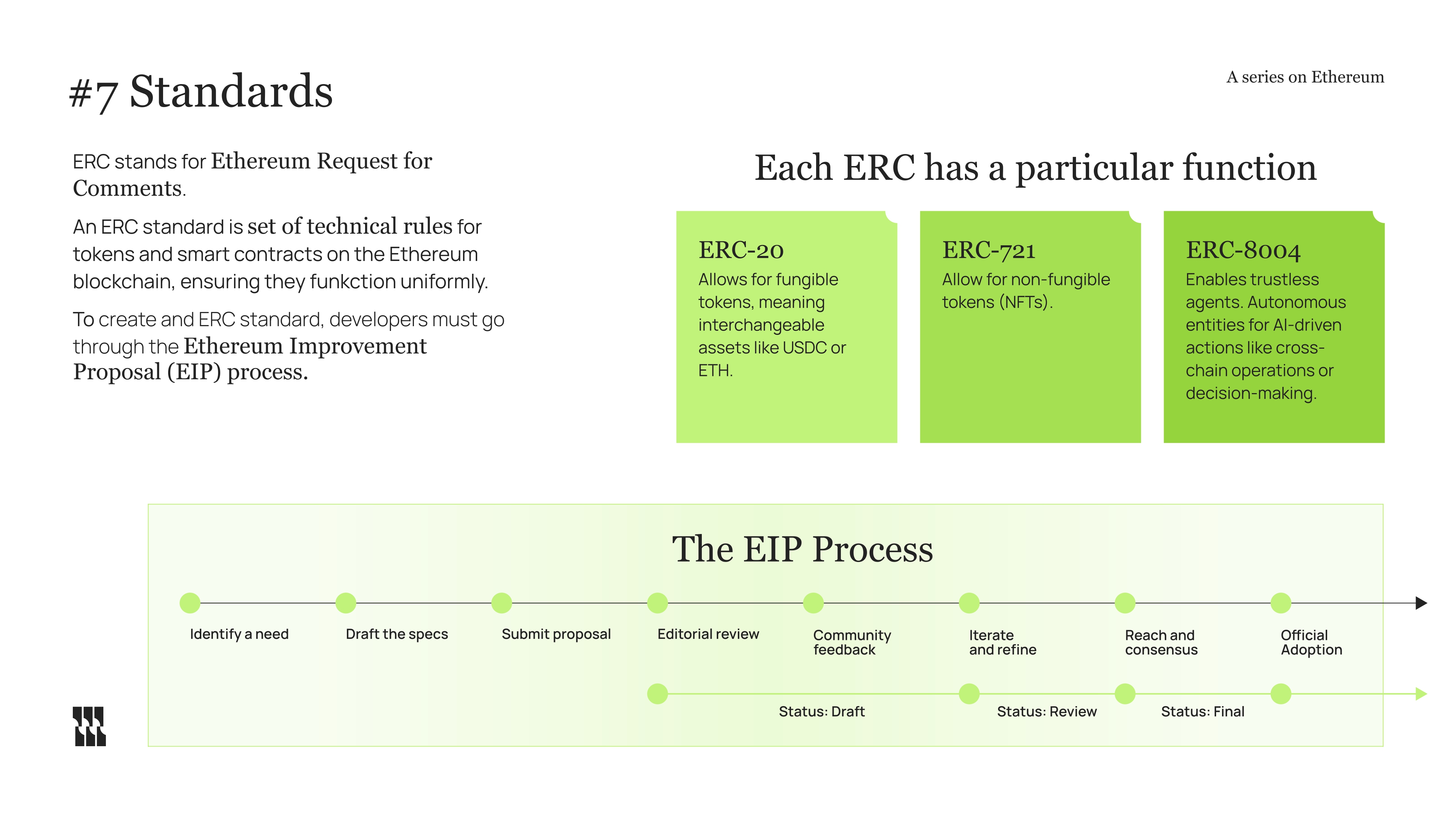
ERC stands for Ethereum Request for Comments. An ERC standard is a set of technical rules for tokens and smart contracts on the Ethereum blockchain, ensuring they function uniformly. ERC standards are open source, meaning anyone can use them and build on top of them. Each ERC has a particular function, for example:
→ ERC-20 allows for fungible tokens, meaning interchangeable assets like USDC or ETH; most transferable tokens on Ethereum follow this standard.
→ ERC-721 allows for non-fungible tokens (NFTs), which boomed a few years ago with projects like CryptoPunks.
→ ERC-8004 enables trustless agents. Autonomous entities for AI-driven actions like cross-chain operations or decision-making, where agents self-execute via on-chain verification.
Side note: Noticed that all ERCs have a number?
This comes from the EIP process described here below. Each new standard receives the next sequential number. That's how you can recognize that ERC-20 has been around for a long time, whereas ERC-8004 is more new.
How are ERC standards created?
Not every idea or code can turn into an ERC. There is a thorough review process known as the Ethereum Improvement Proposal (EIP) process. Here's what that looks like:
- Identify the need: Recognize a gap requiring a new interoperable standard not covered by existing ERCs
- Draft specifications: Create initial documentation including abstract, motivation, test cases, and security considerations
- Submit proposal: Formally submit to the EIP repository for review
- Editorial review: An EIP Editor reviews formatting, assigns an EIP number, and sets status to "Draft"
- Community feedback: The draft is reviewed and discussed across multiple forums and platforms
- Iterate and refine: Implement feedback and run additional tests. Status advances to "Review"
- Reach consensus: Once concerns are resolved and the community achieves "rough consensus", status advances to "Final"
- Official adoption: The finalized standard is listed as an ERC and becomes part of the Ethereum ecosystem
Rough Consensus & Innovation
Rough consensus means a proposal has broad community support without significant, sustained opposition, rather than requiring unanimity or a formal vote. This is often summarized as "not everyone is unhappy."
This shows how ethereum is not only decentralized as a technology, but also as an innovation ecosystem. No small group of decision makers can make or break a new innovation, but rather a community-intelligence decides. It's an open environment where ideas are exchanged, community learns and innovation is the output.
In the next article we'll zoom into why ERC standards matter for traditional finance innovation.

